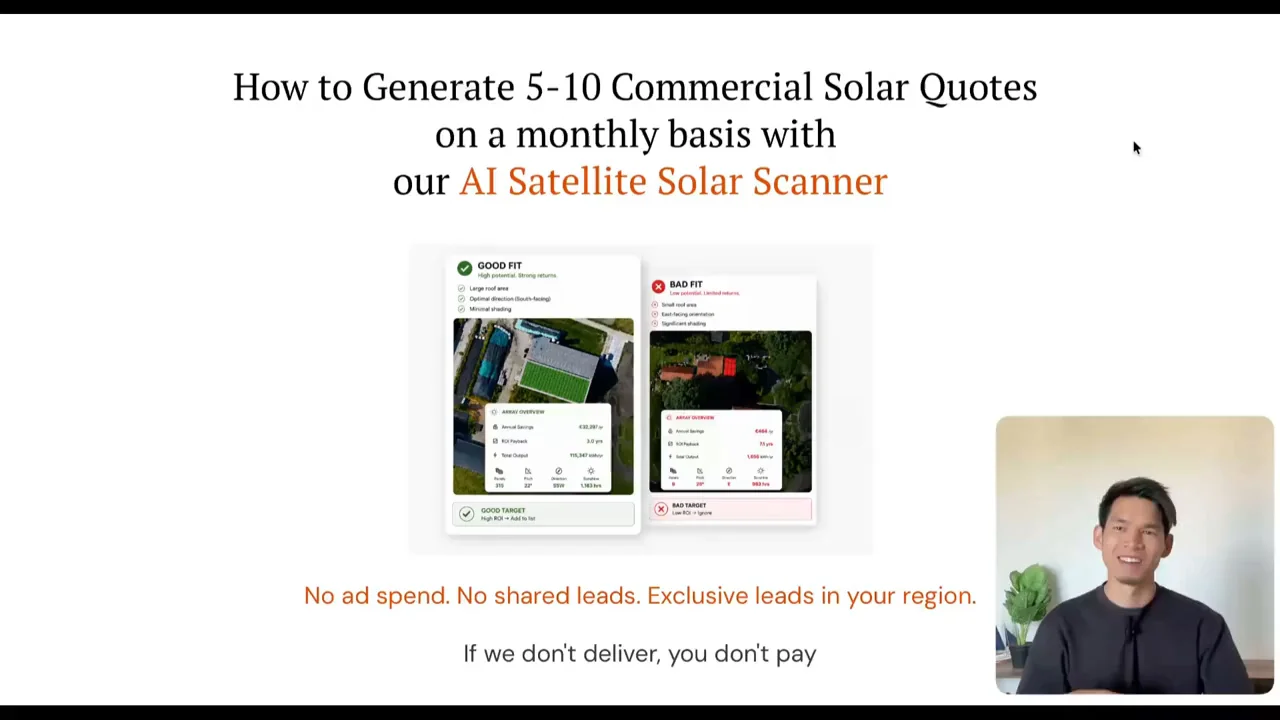
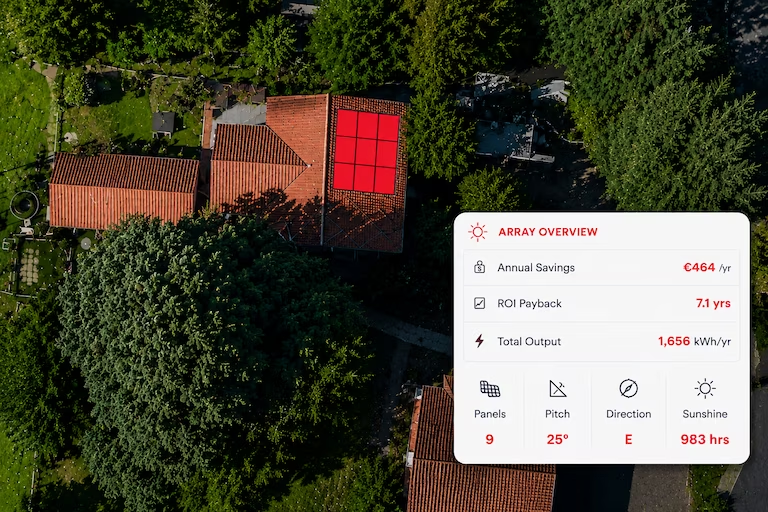
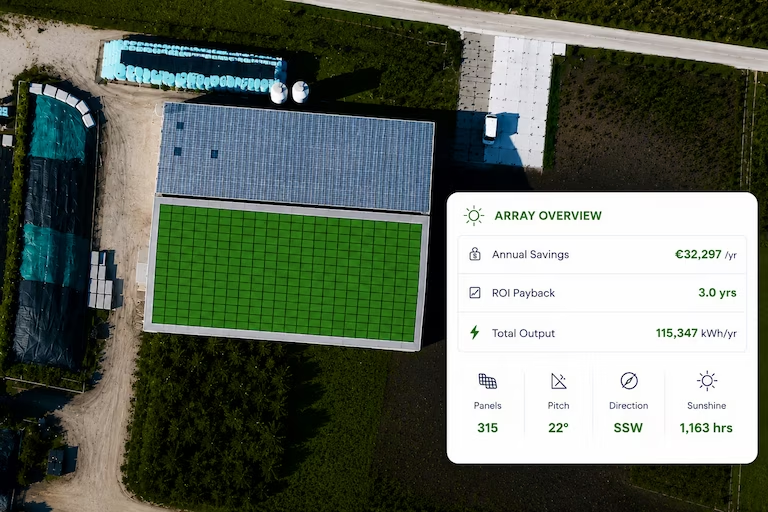
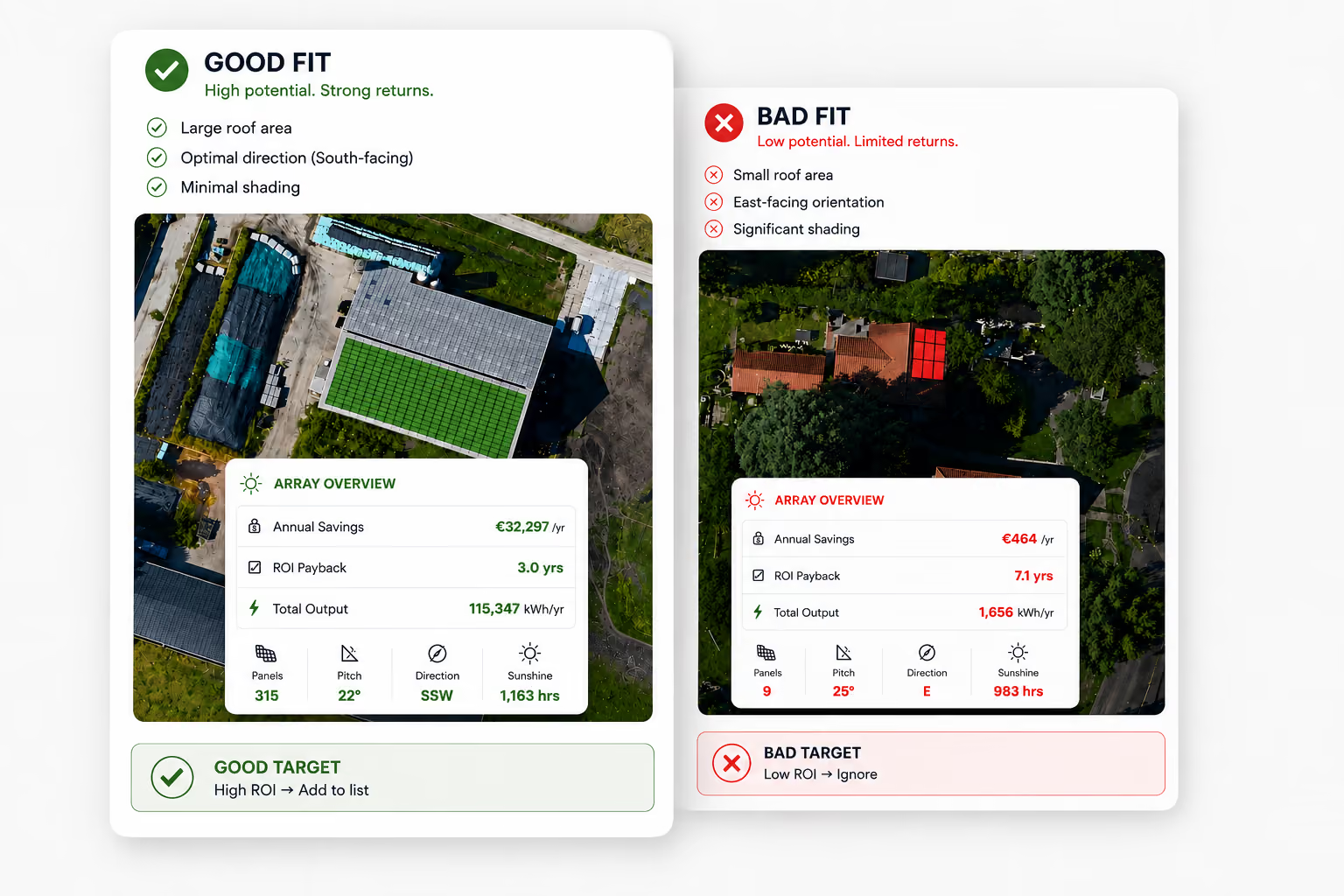
What if I tell you how to generate five to ten commercial solar quotes on a monthly basis with our AI satellite solar scanner? There's no ad spends, no shared leads, and only exclusive leads in your region. The best part is, we don't deliver, you don't pay. In this video, I will show you how to identify and reach your best commercial solar opportunities before your competitors know they even exist. So stick around. If you're a residential solar installer looking to grow into commercial or if you've already started with commercial but you want to scale up, or if you're a solar equipment distributor looking for new areas to grow, or if you're a b to b solar company providing services for the commercial and industry sector, or you're even part of a EPC looking for opportunities before others do. Stick around because this might completely change the way how you generate projects. And the way how most commercial companies generate opportunities is the wrong way around. They buy lead lists, and they share with three other installers, or they have to wait for referrals and they hope or they hope that their phone rings, or they pay a lot for ads that never convert or attract low quality clients. And before a lead even comes in, you waste a lot of resources because there's no prequalification. Also, especially in a residential solar, there's more competition. So meaning you have to compete for the price and you have to even lower your margin that way. You also have to battle with other installers, but you might lose because of you haven't set the right price or you haven't responded quick enough. And as a result, you have a lot of bad quality leads that might lead to low conversion. You waste a lot of resources from your team. You have a higher cost per acquisition. You waste a lot of time, energy. Your team is frustrated. You waste money. And there are also no deals in the pipeline, meaning there's there's no revenue as well. The good news is is that most installers don't have an installation problem, but they have a lead qualifying problem. So it's not that you're getting enough leads, but you're not getting the right type of leads. You're speaking with a person, a gatekeeper, but you're not speaking with the right decision maker. Every opportunity requires a bunch of resources just to disqualify them. You need to get a lead, you need somebody to call them back, you need to get the details on the phone, on the email, you need to review the roof, you need to get back to them and it can take days or weeks of your time before the lead is being responded. And by the time you respond, the lead is already closed. So in order to save time, money and energy, there's good news because we found a solution that can work at scale, where you can find and qualify commercial buildings at scale using AI Solar Scanner. There are three essential steps for this. Just to get better commercial solar leads. Scan, reach, and book. So instead of passively waiting around, you can just be more proactive by reaching out to prospect that were not on the radar before. By the way, who am I? I'm Ken. I'm the founder of Wave ten. I've been in the solar business since two thousand and twelve. I've designed over two thousand systems. I've helped countless installers penalize hundreds of solar businesses, and I was even part of a growing solar company in the race of two hundred million dollars. My mission is to help commercial solar companies to build and grow, and ultimately contribute to a greener world. So here I was handing a solar panel to a solar panel installer. I was here at an exhibition and talking with other injury experts just to make sure that my knowledge and expertise is just up to date as well. Basically, I've been in this field for a long time. But let's dive in the process of scan, reach, and book using AI Solar Scanner. So there are three steps. Step one is to define and scan. So we want to define your region and define the company type that you wanna target and scan for these opportunities. So defining a region basic means you can look at your place where you store events, your company, And we can look at the radius from this, or we can even draw a polygon around the region, or we can even look at the postal codes. Also at the same time, you can look at what kind of company types do you prefer. What kind of companies do you like to work with. We know that for instance farms are very different than offices. Manufacturing companies are much bigger, for instance, than small offices as well. And there are many other company types that you can target. Also, these different company types, there's a whole list of them that you can use in order to really zoom out and then see all of the prospect that you want to target. And how can you find them? So once you have to find the region, you can look at the Google Maps here. You can look for farms or look for other commercial opportunities within your region. There are countless of them. And it depends on the region, depends on what kind of place it is, and what kind of commercial opportunities there are as well. Once you have a a whole once you have all of all of these prospects, we want to combine them and then put them in a list. So the way how it can look like is you have a list of all of the different farms. You want to categorize them. So is it a farm? Is it a farm shop? Is it a cattle farm? Is it Is it a farm for agriculture? This is important because using this data you can estimate the electricity but you can also see and be more precise with your outreach as well. Maybe certain categories have incentives. Maybe they have subsidies as well. So once you have all of this, you can also include the address, the coordinates, the streets, the neighborhoods, region. All of these things can be compiled in a whole list. Right now we're only looking at farms, but this can also be done for offices, this can be done for warehouses, this can be done for manufacturing companies. Basically a whole list of prospects in your region where we want to enrich them with public information. Once you have this, then you want qualify them by using an AI satellite solar scanner. So using the latest techniques, you can look at the satellite data, which is publicly available, and you can use AI to estimate the roof size of the building. So using the roof size, you can also calculate how many panels can actually fit on roof. And if you know how many panels can fit on a roof and if you can give an average energy per panel, then you can also calculate the solar potential per roof. You can calculate how many panels can fit on a roof. You can also calculate the solar radiance based on the location. You can also analyze the building type. Is it a flat roof? Is it a pitch roof? You can calculate the amount of shading it can have. And based on the industry, you can also estimate the amount of energy that this building or this industry could could be using as well. Let me just give you an example on how it looks like. So using AI, you can insert any address. So for instance, this address in the UK where you can see how many panels can fit on given roof. We see a roof which has six degrees of pitch, so it's almost flat. It can fit two ninety panels. It can save about two hundred and twenty four thousand euro per year. The ROI is about four years. This can give you, in a few seconds, the right type of information to see whether this roof is qualified or not. And I would say because the ROI is very low and the roof size is very big, this roof is very qualified. And of course, there are other roof phases that are not being taken into account. So the ROI can even be lower, thus making the prospect even a higher probability to go for. So this not only works for one roof, but this works for any type of roof. Let's say we have a roof here. We want to know how many panels and how many saved, how much it can save per year. We can just click on this, and it can just calculate how many panels it can fit on a roof. Three hundred seventeen in this case. Of course, is a rough estimate of how many panels it can fit, but it can give you a range of how many panels it can fit and whether this is worth it to chase a prospect or not without wasting any resources of your own team's time. So if we look at the amount of solar potential and amount of panels can fit, you can calculate the solar score as well. So roofs that have higher probability and more space or are of a particular type of commercial building or you have less shading, know, you can prioritize them, you can put a lead score on them and you can segment them. These are the companies that we want to target. These are the companies that we don't want to target. For instance, we have another example here. This is bad fit because we have a roof here that's facing east, low amount of panels, nine panels in this case. And it's heavily shaded because of the trees here. So this company or this roof is not suitable for your own outreach. So we would not spend any resources, precious resources of your staff members, of your software, of your time, energy, of money just chasing of a prospect that will never be qualified anyways. Something that we want to use your best resources on, is for instance, a roof that is highly suitable. So we have a roof here where you can see a roof that's facing south where the sun is, of course. We have a very big roof face. There's no shading. The ROI is very low. The annual savings is also very high. So this is a prospect where we want to spend some time on. Once you have all of these data, you can run this AI roof scanner on all of the addresses. So not only one, but you can also do from a whole neighborhood, for instance. Or you can even do from a whole bigger neighborhood or even a town or even a whole region. So the possibilities are really endless with this. But because we have so many, so much data, we also want to only target those that have a high probability of converting, because otherwise we will waste our resources on this. Once you have compiled a list of these are the buildings that we want to target because they are highly qualified, then you have a target list. Next up is to find the decision making details. And you can find them on LinkedIn, you can find them on the career page, or you can find them about the about page on our websites, you can find them on public sources. What we're looking for is the owner, the managing director, the facility manager, sustainability director, finance director, person with a decision maker role within the company. And also knowing what the decision maker's role is within the company, you can also use a different angle and different campaign in order to target them. So for instance a finance director would focus more on ROI, while sustainability director would maybe focus on, for instance, ESG. So there are different angles that you can focus on. And the next step is to reach out to the decision makers once you have these details. So once you have an email of all of these decision makers, you want to compile a simple and personalized mail that provides value to them. You would also need a dedicated core email infrastructure for this because you don't want to burn your main domain. And a sample of a mail could be something like this. Hi, John. I was analyzing rooftops for solar suitability, and your warehouse stood out. Roughly twelve hundred square meters of unshaded south facing roof for a building with your profile. That usually means forty five k pound per year in energy savings, and there are current UK grant schemes available. Can I send a roof analysis over? And this is a sample of a mill targeted to a specific person and of course for different commercial opportunities and different regions there are also ways of generating different meals. And there are also different variables which can be seen in the orange text here. So every orange text can be exchanged for something else, meaning that if we have compiled a template, we can swap these variables in order to make them more personalized into their own prospect as well. So instead of sending a generic mail, we want to send a more personalized mail that is suitable for their situation. Step three is, once we have a mail, is to send them out and wait for a response. So once a reply is given, we want to nourish them and mail them and call them to just get more info. If a client is qualified for you, then you can book them in for an appointment or a site visit. Send them reminders until the meeting is held and a quote is made. If we look at why would this work and we take a step back here, we can just look at the big picture. So a quick research gives the following. In the UK, there are about two eighty ks farms. In the UK, there are more than three million local units, meaning that three more than three million commercial buildings that are that might be suitable for for solar panels. So if I look at stats here, less than ten percent of these commercial rooftops have solar on their roofs. So about three hundred k and less have solar panels on their roofs, meaning that more than three million solar roofs are available right now. And this is an untapped potential for you and your company to go into this as well. We look at the the math for outreach to get monthly quotes. We can look at, for instance, a region which has one million people. For math wise, we can there are about thirty k commercial buildings for a region like this. Let's say only twenty percent of them are worth targeting because of prequalification. So this reduces the market to about six thousand qualified opportunities. And only if one percent one percent responds positively, then that's roughly sixty conversations that you can have. And if you convert ten to fifty percent of them, then you're looking around five to ten commercial qualified quotes. You might think five to ten, that's not a lot, but in this case, we want to target lower quantity for higher quality leads and opportunities in your pipeline. Because these are also bigger. We're not talking about small systems, but we're talking about five hundred ks kilowatt systems or several megawatt systems as well. So even getting one of them, converting them, can even offset your whole revenue. And these are all commercial deals ranging from thirty k to three hundred k plus deals, depending on the system size and all of the add ons, of course. So there are two options for this. One, you can build it in house. You can spend hundreds and hundreds of millions of of hundreds of thousands of dollars on your team, hiring an SDR, hiring an AI engineer, hiring a solar engineer, hiring a sales manager, hiring a lot of people. And you have to invest a lot of time and months in recruiting and training and managing your team. You can spend hundreds of hours learning the best tools and techniques and the best practices. And by the time you're there, you also have to maintain it. So it even takes a lot more time to even get there. It also requires months of trials and error. Or two, you can partner with us because we have a decade of experience in solar. We have a proven system. We you can scale with us as we as we grow, and we also want to have an exclusive partnership with people. So there's only one partner per per region. We want because we want to keep the quality high. And we want to generate five to ten commercial leads on a monthly basis with our AI satellite solar scanner. There's no ad spend, no shared leads, and there are only exclusive leads in your region. And if we don't generate these commercial appointments for you, then you don't pay us as well. So book a strategy call if you'd like to see whether your territory is still available, whether this Scan and Reach book system using l AI satellite data could work for your business. And if we don't believe we can generate opportunities in your market, then we will also tell you. Because we don't want to waste anybody's time, energy as well. Because we also get paid on results basis. And we only work with one partner per region. So if you want to know how to build a predictable pipeline of commercial solar, book a strategy call below, and we'll see you soon. Cheers.